

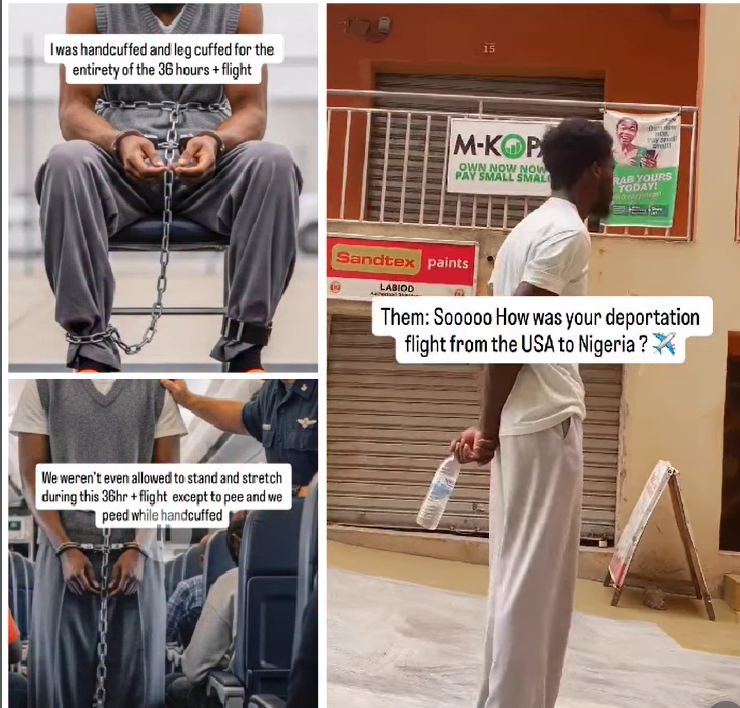
A Nigerian man has opened up about his experience after being deported from the United States, detailing what he described as harsh conditions during the removal process.
According to him, deportees — particularly Nigerians, whom he claimed were the last stop on the flight route — spent a minimum of 36 consecutive hours restrained with handcuffs, leg cuffs, and waist chains. He alleged they were unable to stand or stretch properly throughout the journey.
LAGOS, NIGERIA — As the United States ramps up its nationwide immigration enforcement program in early 2026, stories of the human cost of these operations are beginning to surface. In a testimony that has sparked outrage in both Abuja and Washington, a Nigerian man recently deported from the US has recounted a 36-hour journey characterized by what he describes as "systemic cruelty and inhumane treatment."
The Journey into Darkness The deportee, whose identity is being withheld for safety reasons, arrived at the Lagos Cargo Airport on a charter flight on Wednesday, February 18, 2026. According to his account, the ordeal began in a detention center in Texas, where he was shackled at the wrists and ankles before being transported to a waiting "deportation machine." He alleges that despite the flight taking nearly 36 hours due to multiple stops in Europe and West Africa, he was kept in metal restraints for the entire duration.
"I was treated like a dangerous animal, not a human being," he told reporters in Lagos. "They didn't care that I had lived in America for twelve years. They didn't care that I have a family there. For 36 hours, I couldn't even use the restroom without being dragged like a slave."
Allegations of Medical Neglect Beyond the physical restraints, the man alleged that U.S. Immigration and Customs Enforcement (ICE) officers ignored his requests for his regular blood pressure medication. Reports from human rights observers who monitored segments of the flight check-in process confirm that at least one deportee became "highly agitated and began to unravel" after being denied medication. The witness noted that the man was eventually restrained even more tightly to be escorted through security.
The Wider Context of 2026 Deportations This incident is not isolated. In February 2026 alone, the Department of Homeland Security (DHS) added 18 more Nigerians to a high-risk deportation list, bringing the total under the current expanded enforcement program to 97 individuals. While ICE maintains that these operations target "non-citizens convicted of serious offenses," activists argue that the lack of transparency on these charter flights allows for severe human rights violations.
The costs of these operations are staggering; recent data suggests a single joint EU-US deportation flight can cost taxpayers over €1.5 million, yet oversight remains minimal. In this specific 36-hour journey, the plane reportedly carried families, including five children, who witnessed the "unraveling" and physical restraint of their fellow passengers.
Diplomatic Fallout The Nigerian government has faced increasing pressure to investigate these allegations. Policy experts suggest that if these accounts of "inhumane treatment" are verified, it could strain the already delicate bilateral relations between Nigeria and the US. As of Tuesday, February 24, the Nigeria Diaspora Commission (NiDCOM) has not released an official statement, but the story continues to trend on forums like Nairaland, where citizens are calling for a "dignified return" process regardless of immigration status.





 English (US) ·