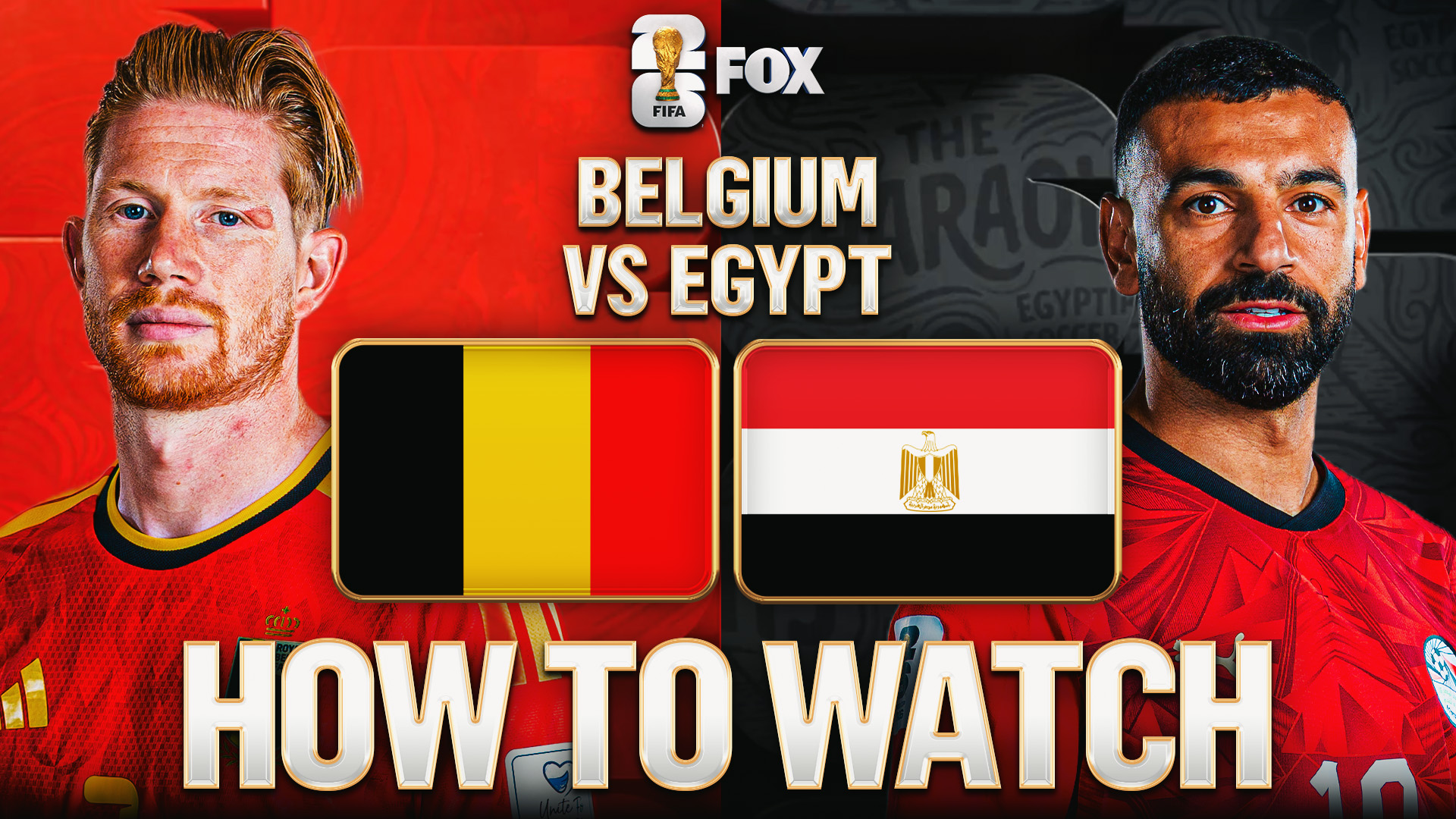
Bob Bradley woke up Monday morning and sent a text to Egypt national team superstar Mohamed Salah. He had two wishes for the player he once coached: Good luck in Egypt's 2026 World Cup opener — and Happy Birthday. Salah — Egypt's captain and arguably its best player ever — turned 34 years old the same day as his team's match against Belgium in Seattle, kicking off what could be his last World Cup. And Bradley is rooting for him. "I haven't gotten to see him in a while, and we always talk about how we've got to figure out a way to get together, but in the meantime, we stay in touch," said Bradley, who previously coached the U.S. men's national team, along with the Pharaohs, and is now a FOX Sports World Cup analyst. Expectations are high for Salah and Egypt, which aims to not only win its first World Cup match but also to advance to the knockout round of the tournament for the first time. With 67 goals and 116 appearances for Egypt ahead of the Belgium opener, the Liverpool legend also has the second-most men's national team goals and is two away from tying current coach Hossam Hassan’s record of 69. On Salah's birthday and ahead of the Pharaohs' first 2026 World Cup match, we spoke with Bradley about his time coaching the Egyptian star and what makes him the beloved icon he is. This interview has been condensed and edited for clarity. Mo Salah made his Egypt national team debut as a teenager about a month before you took over as manager in 2011. When you look back, what characteristics did you see that indicated what type of player he would grow into? Two things. First, from the very beginning in training, you could see how quick and powerful he was, really dynamic. And I was fortunate that I had coached a great player named Hristo Stoichkov [on the Chicago Fire], and Hristo was also strong and powerful and is left-footed. Hristo is a player that would start in wide positions — but not stay wide and play like a winger, but find ways to make really hard runs into the box to be a goal-scoring threat. And when I got to see Salah up close, the bells in my head went off. There are so many similarities with Hristo. The second thing is how much he wanted to be coached and challenged and how you could tell he was so motivated to get better. I think that's been something that has been evident throughout his career. He's just constantly looking for ways to improve. You once said you "immediately" knew Salah was special. What else pointed to that for you? It was the power and the speed that he had. You could tell that he was young, but he was still strong and could get away from defenders and get into good positions. Those things just stood out immediately. When you look back, is there a favorite on-field moment that comes to mind first when you think of him? Yes. At that time in Egypt, on February 1, 2012, there was a massacre in the stadium in Port Said, where 72 young fans were killed in the stadium after a game. When that happened, the [Egyptian Premier] League shut down, and we could only have friendly matches. We had to work very hard because our first [2014] World Cup qualifier was in June, and friendly matches had to be outside the country. So it was a really tough time, but the players were incredible. It was a time when none of them knew what was going on in their careers. They probably weren't being paid, but they still were so committed to the national team. And it was during that period that, in these camps and with these friendly matches outside Egypt, the team started to take shape. The player who had been a big part of the team for years — African player of the year — was [Mohamed] Aboutrika. And you could see on the field the way Aboutrika and Salah developed a very good understanding. So we played the first World Cup qualifier in Alexandria against Mozambique in an empty stadium, which was obviously quite strange, and we won, 2-0. For the second World Cup qualifier, we had to travel and play in Guinea. We were down, 1-0, and then [Aboutrika] scored two goals to make it 2-1. Near the end, Guinea scored, so it looked like a 2-2 game. [Salah] played mostly on the right, and we had worked really hard on his movement — I always use this expression — from outside, meaning you're wider on the field, to inside. After the game was 2-2, we moved forward with the ball, and he made a very strong move without the ball from outside to inside [and] received a great pass. He's left-footed, so when he's coming in from the right, he worked very hard on his ability to curl a ball into the far corner. So he scored the winning goal in that fashion, and I think from that moment on, he was a star, with Aboutrika, on the national team. Off the field, is there a memory that encapsulates him as a leader or as just who he is as a person, rather than a player? His teammates love him. He's humble, and he's just a guy with a fantastic personality. Just to see how much his teammates love him. We stay in touch, in part, because he's always appreciated everything, and in all ways, he's, for me, a great guy. Why do you think he's so beloved by his teammates? How does he endear himself to them? He's funny, he's down to earth. He's just good to be around and makes everybody better in a real way. Salah is obviously a huge international star, but is there something you think the masses don't know about him but should? Probably two things. The first one is out there a little bit because people have written about it, but as a young player, he played at a team called Al Mokawloon. In English, they would call it Arab Contractors. He lived in a village outside Cairo, so it took him three to four hours to get into training and to get home. And when you travel in Egypt, there's something called microbusses. It's a little van [for] public transportation, but people pack inside microbusses, and he had to take a number of different microbusses and get off and get on. So his commitment just to get from where he lived in and out to training every day was incredible. And then the second thing is — and he does it very quietly — he finds many, many ways to give back to causes in Egypt. Egyptians are very proud people, and they love their country. That shows in the way he conducts himself and also in the way that he quietly supports many, many, many good causes. From a global perspective, what do you think Salah's legacy is for the game? His legacy is that when he got to Liverpool, he exploded. And there were steps along the way, but it all came together. Everyone got to see him playing on one of the best teams in the world and become a global star that people mention with the best names in football. For that to happen for a player from Egypt, that was new, and to do it with style and class and grace and a smile, I think made it even better. In what could be Salah's last World Cup, what are your expectations for him and for Egypt as a team? For sure hope that they can play well, that they can get out of the group [stage] and have a chance to go far in the tournament. I know that that would be his dream and his goal for himself and for the team. Do you think they can do it? I hope so. We'll see. What three words would you use to describe Mo Salah? Humble, proud, positive.

 2 hours ago
1
2 hours ago
1











 English (US) ·